


Christopher Delgado’s guilty plea has moved the Goliath Ventures investigation into a new phase.
The former executive has admitted guilt to federal offenses connected to the cryptocurrency investment operation. Federal prosecutors have alleged that the conduct caused losses of at least $250 million.
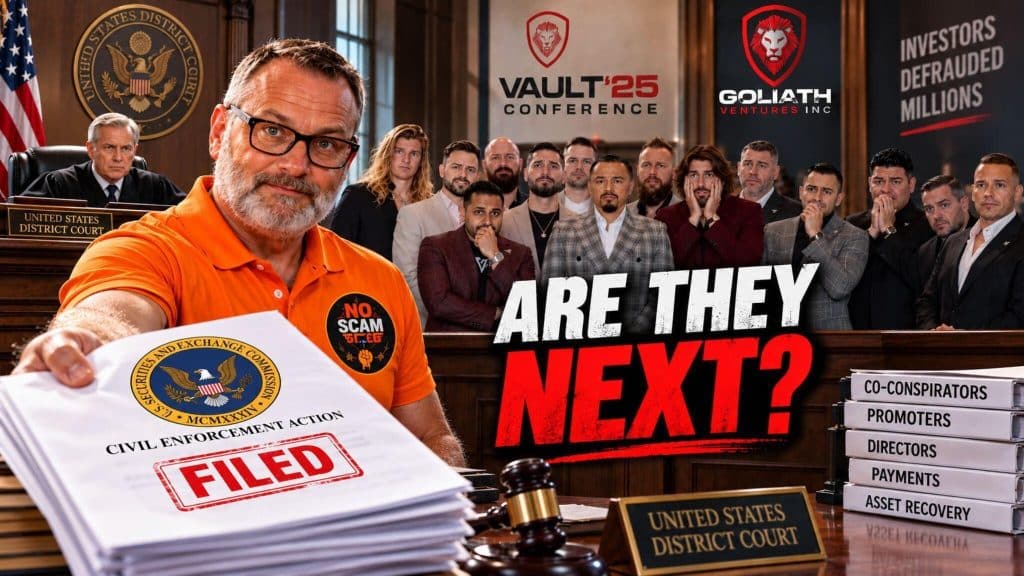
With Delgado’s criminal proceedings now approaching sentencing, attention is increasingly shifting toward the wider Goliath organization.
That creates a question that investors and observers are likely to follow closely: will regulators continue focusing on Delgado, or could the investigation eventually reach other people associated with the company?
There is currently no public confirmation that additional individuals will be charged. Any suggestion that particular associates will face prosecution would therefore be premature.
Nevertheless, the involvement of the Securities and Exchange Commission and the Commodity Futures Trading Commission means Goliath’s activities are being examined through multiple legal and regulatory channels.
Delgado’s Plea Changes the Picture
Delgado’s guilty plea is an important development because it resolves his criminal responsibility for the offenses to which he admitted guilt.
The Department of Justice says Delgado pleaded guilty to conspiracy to commit wire fraud, wire fraud and money laundering. Prosecutors have linked his conduct to losses of at least $250 million.
Federal authorities have also pursued assets connected with the case.
Those developments concern Delgado specifically. They do not establish that other executives, employees, advisers or associates committed crimes.
That distinction could become increasingly important as investigators continue examining the company’s broader operations.
Delgado previously held a senior position at Goliath, meaning he may have knowledge of its internal structure, financial arrangements and communications with investors.
Such knowledge could potentially be useful to investigators, but any information concerning other people would need to be tested against independent evidence.
The Bigger Question: Who Else Knew?
A large investment operation generally involves many people performing different functions.
Some individuals may handle customer communications. Others may work on marketing, accounting, technology, financial administration or investor relations.
The mere fact that someone worked within an organization does not demonstrate that the person knew about alleged misconduct.
Investigators would have to determine what particular individuals knew and whether they intentionally participated in conduct that violated the law.
That inquiry could involve emails, text messages, corporate documents, financial statements, bank records and cryptocurrency transactions.
The evidence may ultimately show that some people played significant roles, while others had little or no knowledge of the alleged activity.
The SEC’s Role
The SEC has brought a civil enforcement action involving Goliath Ventures and Delgado.
The commission alleges that Goliath raised hundreds of millions of dollars from investors while presenting cryptocurrency-related investment opportunities and projected returns.
According to the SEC’s complaint, the money was allegedly not used in the manner represented to investors.
The commission has further alleged that funds were redirected toward other purposes, including payments to earlier investors and personal expenditures.
These are allegations in a civil case and should not be presented as established criminal facts.
However, the SEC’s allegations provide an important indication of the conduct regulators are seeking to establish.
Could the SEC Investigate Other Individuals?
The SEC’s review can extend beyond the criminal charges involving Delgado.
The commission can examine whether securities laws were violated by a company or by individuals connected with an investment offering.
That could include questions about how the opportunity was promoted, what investors were told and whether financial disclosures accurately described the use of their money.
Investigators could also examine who was responsible for preparing investor materials and who approved specific representations.
If evidence demonstrates that additional individuals knowingly participated in securities violations, the SEC could potentially take further action.
But that is not the same as saying such action is inevitable.
At present, the public record does not establish that every person associated with Goliath is under investigation or will face enforcement.
The CFTC Is Pursuing Its Own Case
The Commodity Futures Trading Commission has also filed a civil action involving Goliath and Delgado.
The CFTC alleges that roughly 1,600 customers contributed at least $397 million and that investors were given misleading information about their investments and anticipated returns.
The agency is seeking various forms of relief through its proceeding.
The separate SEC and CFTC actions demonstrate the breadth of the federal response to the allegations surrounding Goliath.
They also mean that information about the company’s activities could emerge through more than one regulatory process.
Why the Different Dollar Figures Matter
The government filings refer to several substantial sums.
The DOJ has said Delgado admitted responsibility for at least $250 million in losses.
The SEC alleges that Goliath raised at least $425 million from more than 1,300 investors.
The CFTC has cited approximately $397 million contributed by around 1,600 customers.
Those amounts should not simply be added together.
They come from different proceedings, involve different allegations and may reflect different groups of customers or different methods of calculation.
What they do show is the scale of the financial activity that authorities are examining.
The Financial Trail Could Be Critical
If investigators begin looking more closely at other individuals, financial records could become some of the most important evidence.
Bank statements can show where funds were transferred.
Corporate records can reveal how transactions were classified.
Cryptocurrency ledgers can document the movement of digital assets between addresses.
Exchange records may help identify the people behind particular wallets.
Communications can provide context for financial transactions and indicate who knew about or authorized certain decisions.
No individual record necessarily proves wrongdoing.
But evidence from several independent sources can help investigators reconstruct events and determine who was involved.
Cryptocurrency Leaves a Digital Trail
One unusual feature of cryptocurrency investigations is the permanent nature of many blockchain records.
Transactions can often be viewed publicly, allowing investigators to trace the movement of digital assets.
The challenge is identifying the people controlling the wallets.
A blockchain address alone may not reveal the name of the person behind it.
Investigators may therefore seek information from exchanges, banks, corporate records and electronic communications.
Once a wallet is linked to a particular person or organization, investigators can potentially follow transactions through multiple stages.
That could become relevant if authorities are attempting to determine whether other individuals knowingly handled or benefited from funds connected to the alleged scheme.
Delgado’s Knowledge Could Matter
Delgado’s previous position within Goliath could make him an important source of information.
He may know how responsibilities were divided within the company and who was involved in different aspects of the operation.
He may also have knowledge of investor communications, financial decisions and internal discussions.
However, information supplied by a defendant should not automatically be accepted as fact.
Investigators would need to compare any significant statements with documents, financial records and other testimony.
A statement about another individual may generate an investigative lead, but it would not by itself establish that person’s guilt.
A Connection Does Not Equal Criminal Responsibility
This point is especially important as attention turns toward other people connected to Goliath.
An employee may have performed ordinary duties without knowing about alleged misconduct.
A consultant may have provided legitimate services without understanding the company’s financial practices.
Someone involved in marketing may have relied on information supplied by senior management.
A person appearing in promotional material may also have been unaware of what was allegedly happening elsewhere within the organization.
The legal question is therefore much narrower than simply asking who knew Delgado.
Authorities would need to examine each person’s actions and knowledge individually.
Areas That Could Receive Greater Scrutiny
If regulators expand their examination, they could review several categories of information.
Investor presentations may be compared with the company’s actual financial activity.
Advertising and promotional campaigns could be analyzed for statements concerning returns.
Internal correspondence could help identify who created or approved particular claims.
Accounting records could reveal how investor funds were transferred or categorized.
Compensation records could show whether particular individuals benefited financially from bringing in new customers.
Authorities could also examine who had access to company accounts and who had authority to make important financial decisions.
The goal would be to determine whether violations occurred and whether specific people can be connected to them through evidence.
Asset Recovery Could Be Just as Important
The investigation also has a financial-recovery component.
Federal authorities say Delgado has agreed to forfeit substantial property and luxury assets associated with the offenses.
Recovering assets can be particularly important when investors have suffered significant losses.
However, asset forfeiture does not mean that victims will automatically recover the full amount they lost.
Property can be subject to competing claims and court procedures.
Some assets may need to be liquidated before proceeds can be distributed.
Other funds may have already been spent or transferred.
The ultimate recovery will therefore depend on what assets can be located, preserved and legally distributed.
Bankruptcy May Provide Another Source of Information
Goliath’s bankruptcy proceedings could also play an important role.
Bankruptcy requires an examination of the company’s assets, debts and creditor claims.
That process can help establish the financial resources still available and the obligations that must be addressed.
Documents filed during bankruptcy may also provide additional information about the company’s finances.
For investors, the proceeding could determine how remaining assets are handled.
For investigators, it may offer another source of records that helps explain the company’s financial history.
What Investors Still Want to Know
Delgado’s guilty plea does not answer all of the questions facing investors.
Many will want to know where their money ultimately went.
They will also want to know how much can potentially be recovered.
Other questions concern the investment representations made to customers and the individuals responsible for those representations.
Perhaps the most sensitive question is whether other people knowingly participated in the alleged conduct.
Those answers may emerge through several separate proceedings rather than from a single case.
The criminal prosecution, SEC action, CFTC lawsuit, bankruptcy process and asset-recovery efforts each address different parts of the overall picture.
Why Online Accusations Can Be Dangerous
Large financial investigations frequently generate speculation on social media.
People can become targets of online accusations simply because they worked for the same organization, appeared with an executive or had a business relationship with a defendant.
Those circumstances are not sufficient to establish wrongdoing.
There is an important difference between being mentioned in a legal filing and being accused of violating the law.
There is another distinction between a civil allegation and a criminal conviction.
Those differences should be maintained when discussing anyone who has not been formally accused by authorities.
What Could Lead to Additional Action?
Authorities could potentially broaden their investigation if new evidence identifies other participants.
For example, internal messages could reveal that an individual knowingly helped make misleading statements to investors.
Financial records could show that someone knowingly transferred or concealed funds.
Other evidence could potentially establish that an individual benefited from the alleged activity while understanding its nature.
But investigators may also discover evidence that excludes particular people.
An employee could have been unaware of the alleged misconduct.
An outside adviser could have performed legitimate work without knowledge of the company’s internal practices.
Ultimately, evidence rather than association will determine whether further action is justified.
A Broader Warning for Crypto Investors
The Goliath case also provides a lesson for anyone considering cryptocurrency investment opportunities.
Complex technology can make an investment appear sophisticated.
But technical language does not establish that an investment is legitimate.
Potential investors should understand how returns are supposedly generated and where their funds are actually held.
They should also consider whether claims about performance can be independently verified.
Promised returns that appear unusually high, stable or predictable should be approached carefully.
The underlying business model matters more than impressive terminology.
The Next Stage of the Case
Several legal developments will continue simultaneously.
Delgado’s criminal case is expected to move toward sentencing.
The SEC’s civil enforcement action remains in progress.
The CFTC’s case will continue through its own legal process.
Authorities can continue pursuing assets associated with the alleged offenses.
Goliath’s bankruptcy proceedings may also reveal more about its financial position and outstanding obligations.
Meanwhile, investigators may continue examining the company’s transactions, communications and relationships.
Whether those efforts produce additional defendants or regulatory targets remains unknown.
Will Regulators Look Beyond Delgado?
There is not enough public evidence to say that the SEC has decided to pursue additional Goliath executives or associates.
It would therefore be premature to label any particular person a co-conspirator without an official allegation supported by evidence.
What is clear is that Goliath remains subject to scrutiny beyond Delgado’s individual criminal case.
The SEC and CFTC proceedings provide separate regulatory avenues for examining the company’s activities.
The DOJ prosecution, asset-recovery efforts and bankruptcy process may also generate information that helps authorities understand what happened.
If evidence identifies additional violations or participants, regulators could potentially broaden their actions.
If the evidence does not support those conclusions, the current defendants and allegations may remain the focus.
The Investigation Is Still Developing
Delgado’s guilty plea resolves an important part of the criminal proceedings, but it does not necessarily close the larger Goliath story.
Questions remain about the movement of investor money, the company’s internal decision-making, communications with customers and the knowledge of people working around the organization.
Those questions could be answered gradually through financial records, blockchain evidence, company documents, testimony and court proceedings.
For investors, the most important issues are accountability and the possibility of recovering their losses.
For investigators, the central principle is simple:
Follow the evidence.
Being connected to Goliath does not establish wrongdoing.
Working alongside Delgado does not automatically make someone a co-conspirator.
If evidence ultimately shows that other individuals knowingly participated in unlawful conduct, they could face scrutiny or enforcement.
If the evidence demonstrates that others were unaware of the alleged activity, their association should not be treated as proof of guilt.
For now, Delgado’s guilty plea represents a significant development—but not necessarily the end of the Goliath investigation.
The coming SEC, CFTC, DOJ and bankruptcy proceedings could determine whether the case remains centered on Delgado or whether regulators eventually uncover evidence that points toward a wider network of responsibility.
